

With the 2021 and 2024 energy code cycles now in place and adoption continuing across a growing number of states and jurisdictions, several important changes affect metal buildings when compared to prior energy code cycles, including IECC 2018.
When we step back and review where those changes show up, a few key provisions rise to the top: vapor control, air barrier requirements, thermal bridging, and energy credits. Each reflects meaningful changes from prior code cycles and carries direct implications for how metal building systems are designed and installed.
To keep the discussion focused, these updates are addressed in a series of blog posts, which I’ll publish weekly. Today, we’re covering the International Building Code (IBC) updates for vapor retarders. Next week, we’ll talk about the IECC code changes for air barriers and thermal bridging, and then energy credit requirements tied to compliance. Each of these topics reflect changes that directly impact how metal building systems perform, particularly when compared to framed construction.
Ready? Let’s dive in.
Vapor Retarder Updates
IBC Section 1404.3
One of the first changes I have been dealing with for quite some time is IBC Section 1404.3, Vapor Retarders. This section applies to walls only, and there have been changes to vapor retarder classifications in some climate zones. As a reminder, there are three classes of vapor retarders: Class I, Class II, and Class III.
TABLE 1404.3.1 - Vapor Retarder Materials and Classes
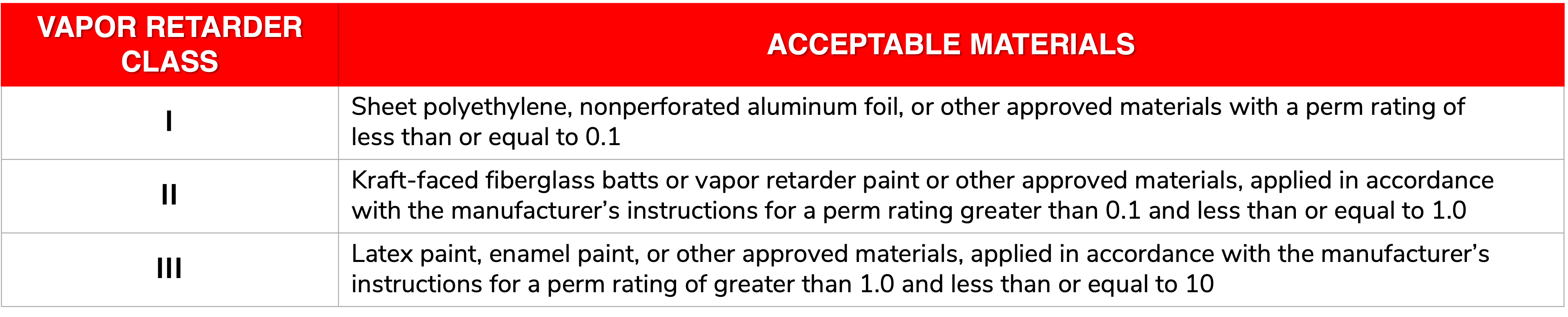
Source: IBC
In many climate zones, the codes require continuous insulation (CI) as part of the envelope for framed wall assemblies. When you combine the continuous insulation, the weather-resistive layer, the thermal layer, and the cavity-filled framed wall, those layers begin to create some vapor-control characteristics within the assembly, even without relying entirely on a traditional vapor retarder. That is one of the reasons it became important for the code to adjust the vapor retarder classifications in certain climate zones and construction types.
Now, when you look at metal building walls, the story is different.
1404.3 Vapor Retarders
Vapor retarder materials shall be classified in accordance with Table 1404.3(1). A vapor retarder shall be provided on the interior side of frame walls in accordance with Tables 1404.3(2) and 1404.3(3), or an approved design using accepted engineering practice for hygrothermal analysis. The appropriate climate zone shall be selected in accordance with Chapter 3 of the International Energy Conservation Code.
Source: IBC
IECC and ASHRAE 90.1 treat framed walls and metal building walls as separate construction types, and they each have different R-value and U-value requirements for compliance. Metal building walls insulated with fiberglass do not require continuous insulation under the U-value path, so they should not automatically be viewed through the same lens as framed wall construction.
That distinction matters. Metal building walls perform differently when Class I vapor retarders are used. In many cases, moisture migration is relieved through the wall panels themselves, or it drains down the panel and exits through the trim at the base of the wall. I cannot say that metal building walls are exempt from Section 1404.3, but I do think there are other factors that should be considered before making a final decision.
The exceptions to 1404.3 are listed below. Exception 4 is of note for metal buildings.
Exceptions
- Basement walls.
- Below-grade portion of any wall.
- Construction where accumulation, condensation or freezing of moisture will not damage the materials.
- Class I and II vapor retarders with vapor permeance greater than 1 perm when measured by ASTM E96 water method (Procedure B) shall be allowed on the interior side of any frame wall in all climate zones.
Source: IBC
It is also worth noting that the vapor retarders used in metal buildings are typically tested under ASTM E96 Method A, the dry cup method, which usually gives the more favorable perm rating. ASTM E96 Method B is generally not listed or tested, but we have asked manufacturers to provide any available data that could help support use of the exception above.
Weather Protection Updates
The other IBC change that deserves attention is Section 1402.2, Weather Protection. Again, this section applies to walls only, but it can become a real issue depending on the wall assembly.
1402.2 Weather Protection
Buildings shall be provided with a weather-resistant exterior wall assembly. The exterior wall assembly shall include flashing, as described in Section 1404.4. The exterior wall assembly shall be designed and constructed in such a manner as to prevent the accumulation of water within the exterior wall assembly by providing a water-resistive barrier behind the exterior veneer, as described in Section 1403.2, and a means for draining water that enters the assembly to the exterior. Protection against condensation in the exterior wall assembly shall be provided in accordance with Section 1404.3.
Source: IBC
If your wall panels are tested per ASTM E331, they are exempt, since that test requires all framed openings and wall panel seams to be sealed, along with the top and bottom panel areas.
The other exemptions are listed below:
Exceptions
- A weather-resistant exterior wall envelope shall not be required over concrete or masonry walls designed in accordance with Chapters 19 and 21, respectively.
- Compliance with the requirements for a means of drainage, and the requirements of Sections 1403.2 and 1404.4, shall not be required for an exterior wall envelope that has been demonstrated through testing to resist wind-driven rain, including joints, penetrations and intersections with dissimilar materials, in accordance with ASTM E331 under the following conditions:
Source: IBC
Exemption two can be especially difficult. I have had situations where inspectors accepted a weather-resistive barrier installed on the outside of the girts before the wall panels went on, particularly when the wall panel system itself was not an ASTM E331-tested product. That does not make it a blanket solution, but it does show that this section may require some project-by-project discussions.
As more states and jurisdictions adopt the 2021 and 2024 code cycles, these updates will continue to shape how metal building wall systems are designed, detailed, and reviewed in the field. For contractors, erectors, and builders, that means the details matter more than ever. Understanding how vapor retarders, weather protection, and code exceptions apply to metal buildings can help prevent confusion during design review, avoid issues with inspectors, and reduce costly changes once a project is already underway.
The more familiar you are with where the codes are heading, the better prepared you will be to make informed insulation and wall assembly decisions, and avoid surprises that can affect schedule, cost, and compliance. In my next post, I’ll cover air barriers and thermal bridging, two areas that are already raising important questions for metal building projects and will only become more important in the cycles ahead.
Resources
Useful Links

Subscribe to The Code Man Blog

Next week, I’ll be breaking down everything you need to know about air barrier compliance and thermal bridging.
Subscribe to my email list to get my next update delivered straight to your inbox.
All for now,
Bill “The Code Man” Beals
—–
Bill Beals, District Manager of Therm-All, is a 40-year veteran of the metal building industry and a contributing member of several committees, including the Metal Building Manufacturers Association’s Energy Committee and the National Insulation Association’s Laminators Committee. Bill also belongs to ASHRAE and the International Code Council (ICC). He has contributed to over 100 articles and reference guides on commercial energy codes, and has instructed AIA-accredited courses for over eight years. Bill was inducted into the Metal Construction News Hall of Fame in 2024.