
In last week’s post, I covered the recent IBC updates related to vapor retarders and weather protection. This week, I want to turn the focus to IECC, because this is where some of the biggest changes affecting metal buildings are taking place.
The two areas we’ve been helping builders navigate are air barrier compliance and thermal bridging. As the 2021 and 2024 IECC code cycles continue to be adopted, we’ve seen a greater focus on how the building envelope is detailed, how assemblies perform in the field, and how compliance is verified.
For contractors, builders, and architects, that means the conversation is no longer just about meeting an insulation value on paper. It is also about controlling air leakage, understanding when and how thermal bridging applies to your application, and making sure the building is detailed in a way that will hold up during inspection and testing.
Let’s get started.
Air Barriers
Air Barrier Compliance Methods
The first major change in IECC is the air barrier requirement. In the previous code cycles, this path was relatively simple. You had three options:
- The materials approach,
- The assembly approach, or
- Blower door testing
Most builders chose the materials approach. In other words, you selected the material that would serve as the air barrier, detailed it accordingly, and moved on. That path has changed.
Under IECC 2021 and IECC 2024, you now have two compliance choices, and both require third-party testing or verification.
Option 1: Visual Verification
The visual verification method is almost always the easier choice for a large non-residential commercial building. It requires review of the important components prior to close-in, allowing corrections to be carried out and documented:
-
- Design Review: A registered design professional or approved agency reviews the construction documents to ensure the air barrier details are clearly shown and compliant with the code including properly selected air barrier and sealing materials
-
- Site Observation: An approved party inspects the installation of the continuous air barrier and its components during construction.
-
- Documentation: Any deficiencies found during either the design review or site observation must be documented, along with the details of the corrective measures taken. In most cases, a final building envelope commissioning report is required to be delivered to the building owner and code official, which includes the equivalent of an issues log and corrective actions.
Source: IECC
Most of the builders we’ve worked with prefer the visual verification method to ensure the building’s air barrier is compliant.
Option 2: Whole Building/Blower Door Testing
For large commercial buildings this may be a risk because the project team won’t know if they are in compliance until after the test is performed. Passing a whole building blower door test requires careful consideration of air barrier details including installation verification.
Source: IECC
Blower door testing should not intimidate the average metal building contractor or designer. This testing is not new to our industry.
If you’ve never had to conduct a blower door test, a blower door, which is essentially a powerful fan, is mounted to the frame of a walkthrough door and is used to pull the air out of the building in order to lower the air pressure indoors. Then, the higher air pressure from outside enters the building through all unsealed openings, which is used to calculate the air infiltration rate of the building.
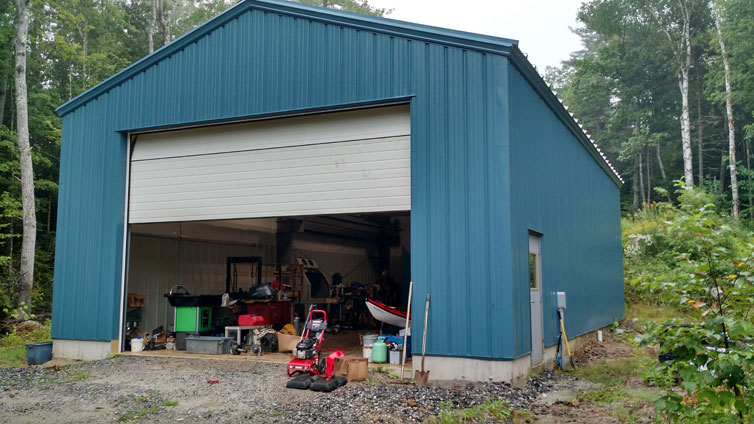
Image shows a metal building preparing to undergo blower door testing.
In most cases, metal buildings perform very well and the results fall well within the allowable leakage rate. However, if your building fails the blower door test, you must make all repairs until it passes it, so I highly recommend hiring an air barrier consultant if a contractor, architect or city requires blower door testing.
The air leakage rate requirements have also tightened slightly. The previous code cycles used a 0.40 leakage rate. Now, IECC 2021 and IECC 2024 have reduced that to 0.35, based on the language below. There is still a path where a 0.45 leakage rate may pass if the area of failure is inaccessible, but that should only be considered as a last resort.
C402.6.2 Air Leakage Compliance
Air leakage of the building thermal envelope shall be tested by an approved third party in accordance with Section C402.6.2.1. The measured air leakage shall not be greater than 0.35 cubic feet per minute per square foot (1.8 L/s x m2) of the building thermal envelope area at a pressure differential of 0.3 inch water gauge (75 Pa) with the calculated building thermal envelope surface area being the sum of the above- and below-grade building thermal envelope.
Exceptions:
- Where the measured air leakage rate is greater than 0.35 cfm/ft2(1.8 L/s × m2) but is not greater than 0.45 cfm/ft2(2.3 L/s × m2), the approved third party shall perform a diagnostic evaluation using a smoke tracer or infrared imaging. The evaluation shall be conducted while the building is pressurized or depressurized along with a visual inspection of the air barrier in accordance with ASTM E1186. All identified leaks shall be sealed where such sealing can be made without damaging existing building components. A report specifying the corrective actions taken to seal leaks shall be deemed to establish compliance with the requirements of this section where submitted to the code official and the building owner. Where the measured air leakage rate is greater than 0.45 cfm/ft2(2.3 L/s × m2), corrective actions must be made to the building and an additional test completed for which the results are 0.45 cfm/ft2(2.3 L/s × m2) or less.
Source: IECC 2024
The main takeaway here is that metal buildings can test very well, but passing does not happen by accident. It takes proper detailing, clear communication, and coordination between the trades before the building ever gets to the test stage.
Thermal Bridging
The next change that impacts metal buildings is the thermal bridging section in IECC 2021 and IECC 2024 Section C402.7.3.
Let’s go back for a second. You may recall that thermal bridging is the loss of building energy through components that “bridge” across the insulation layer in a wall or roof assembly. Thermal bridging happens when a more conductive element, meaning one with a lower insulating value, creates an easier path for heat to move through the building enclosure. The resulting heat loss and potential for condensation are issues no builder wants to face in the field.
While thermal bridges are often associated with older buildings that were not insulated particularly well, they can also show up in new construction and can occur anywhere in a wall or roof assembly. When it comes to metal buildings though, thermal bridging does not apply to the typical metal building envelope as it relates to purlins and girts under Exception 4. If you’re asking why, it’s because all published ASHRAE 90.1 U-values already account for the thermal bridging effects of purlins and girts in those tested assemblies.
C402.7 Thermal Bridges in Above-Grade Walls
Thermal bridges in above-grade walls shall comply with this section of an approved design.
Exceptions:
- Buildings and structures located in Climate Zones 0 through 3.
- Any thermal bridge with a material thermal conductivity not greater than 3.0 Btu/h x ft x F (5.19W/m x K).
- Blocking, coping, flashing and other similar materials for attachment of roof coverings.
- Thermal bridges accounted for in the U-factor or C-factor for a building thermal envelope.
Source: IECC 2024
However, there are conditions where thermal bridging does become a code issue.
One example is when a lower roof canopy penetrates the wall’s thermal envelope. This condition meets the point thermal bridging part of the code, and the area will have to be addressed.

Image depicts a metal building with a lower roof canopy.
The Takeaway
The biggest takeaway is that these requirements should be considered early, not after the drawings are done or the building is already in the field. The more attention given to detailing, coordination, and tested assembly performance up front, the easier it becomes to avoid delays, failed inspections, and costly corrections later.
Remember, metal building assemblies have their own tested U-values, performance paths, and code considerations. Knowing when and where the provisions apply will help you make better building decisions in the field without risking compliance.
In the next post, I’ll break down COMcheckTM energy credits and the updated requirements to reach compliance under this method.
Subscribe to The Code Man Blog
Subscribe to my email list to get my next update delivered straight to your inbox.
All for now,
Bill “The Code Man” Beals
—–
Bill Beals, District Manager of Therm-All, is a 40-year veteran of the metal building industry and a contributing member of several committees, including the Metal Building Manufacturers Association’s Energy Committee and the National Insulation Association’s Laminators Committee. Bill also belongs to ASHRAE and the International Code Council (ICC). He has contributed to over 100 articles and reference guides on commercial energy codes, and has instructed AIA-accredited courses for over eight years. Bill was inducted into the Metal Construction News Hall of Fame in 2024.