

In last week’s post, I covered the recent air barrier compliance and thermal bridging requirements under IECC 2024. To wrap up this three-part blog series, I want to answer a question that’s on a lot of builders’ minds: How do I run a successful COMcheck™ under IECC 2024?
Let’s say you’re working on a new metal building using IECC 2024, and you’ve already done what would have worked under IECC 2021. You selected the roof and wall insulation, designed the envelope around a path that could meet the required 10 energy credits, and expected the project to move through COMcheck without much trouble.
Then you open the “Credits” tab. Instead of the 10 credits you expected under IECC 2021, the project is now showing a requirement of 90 credits under IECC 2024.
This is the shift more erectors, contractors, and designers are running into under IECC 2024. The credit path inside COMcheck no longer looks the way it did in the previous cycle.
In today’s blog, I’ll walk through what changed, why the credit values are so much higher, and what metal building project teams should be paying attention to if they want to run a successful COMcheck under IECC 2024.
Energy Credits
Requirements
Both IECC 2021 and IECC 2024 require projects to satisfy various energy credit requirements before a COMcheck can be run successfully. Many teams begin by focusing on the roof and wall assemblies, only to find that the credit requirement also depends on lighting, mechanical systems, and other building inputs. In other words, the envelope matters, but it is not the only part of the conversation.
The required credit total is based on two main factors:
- Climate zone
- Occupancy type
These factors will have a major impact on your building’s compliance because it means the same building may require 90 credits in one climate zone and only 84 credits in another. Before the team starts selecting credit options, the first step is understanding which requirements apply to the project at hand.
Energy Credit Categories
There are several energy credit categories that may be used when designing a code-compliant building. For metal buildings, some of the most common energy credit categories include:
- Thermal envelope improvements
- Mechanical system efficiency
- Fenestration performance
- Ventilation with energy recovery
- Renewable energy use
- Load management and demand response
Depending on the project, some of these categories will contribute more than others. In many metal buildings, the envelope still makes a meaningful contribution to the overall credit total, especially when insulation and air leakage are addressed.
How Energy Credits Worked Under IECC 2021
Under IECC 2021, the energy credit process in COMcheck was more straightforward.
Once the user entered the occupancy type and climate zone, the software showed the required credits under the “Credits” tab and displayed the available compliance options.

Image shows a COMcheck project requiring 10 energy credits to meet compliance.
In the above example, only 10 energy credits were required, which was true in many cases under IECC 2021. The next step was selecting the credit categories that would help a building reach the 10 required credits.
Some categories carried more value than others, but I found that 10 energy credits could usually be achieved with the following choices:
- C406.8 Enhanced Envelope Performance: through added roof and wall insulation
- C406.9 Reduced Air Infiltration: through blower door testing
- C406.10 Energy Monitoring

Image shows a list of COMcheck energy credit categories with C406.8 and C406.9 highlighted under the Envelope category, and C406.10 highlighted under the Monitoring category.
Once the path was defined, the team would then review the referenced C406 sections in IECC 2021 to confirm exactly what was required for each selected credit category.
How IECC 2024 Changed the Credit Requirements
Under IECC 2024, the energy credit structure is quite different. The required credit totals are significantly higher than they were in IECC 2021. A project type that may have been working with 10 credits under IECC 2021 may now be looking at 90 credits under IECC 2024, depending on the project conditions.
The values assigned to specific credit categories are also higher now. Table C406.1.1(1) lays out the new energy credit requirements by occupancy type.
Table C406.1.1(1) Energy Credit Requirements by Building Occupancy Group
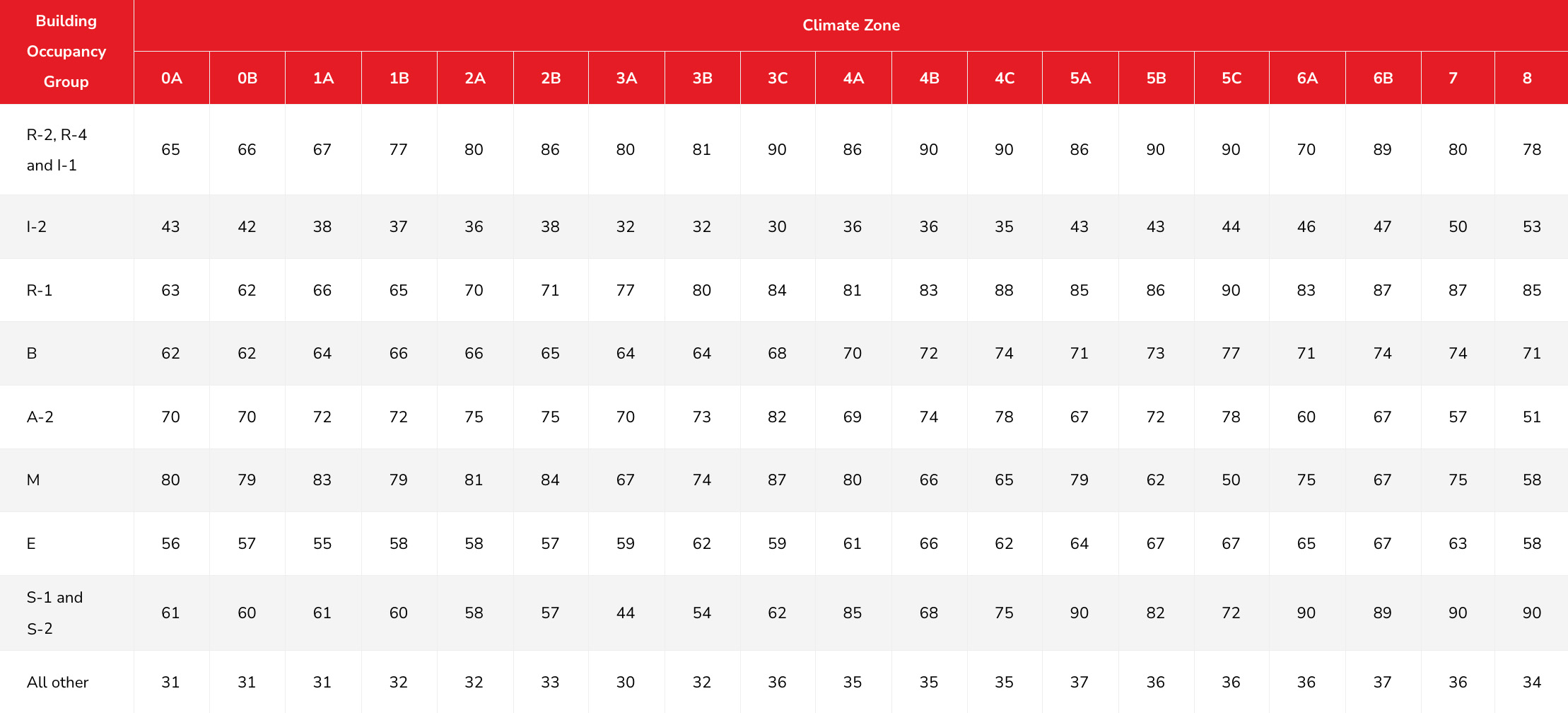
Source: IECC 2024
For most metal building projects, the building will typically fall under the “All Other” occupancy type. For exceptions, or for a closer of the defined occupancy groups, refer to Section 302.1 of the International Building Code (IBC).
302.1 Occupancy Classification
- Assembly (see Section 303): Groups A-1, A-2, A-3, A-4, and A-5
- Business (see Section 304): Group B
- Educational (see Section 305): Group E
- Factory and Industrial (see Section 306): Groups F-1 and F-2
- High Hazard (see Section 307): Groups H-1, H-s, H-3, H-4, and H-5
- Institutional (see Section 308): Groups I-1, I-2, !-3, and I-4
- Mercantile (see Section 309): Group M
- Residential (see Section 310): Groups R-1, R-2, R-3, and R-4
- Storage (see Section 311): Groups S-1 and S-2
- Utility and Miscellaneous (see Section 312): Group U
Source: IBC
More Credit Options Under IECC 2024
Another major change is that IECC 2024 includes significantly more credit options than the previous code cycle. A full list of the new energy credit options can be found in Tables C406.2 (1) – C406.2 (9). This expanded list of credit options gives project teams even more ways to build a compliance strategy. It also means the credit discussion needs to start earlier in the building design process because more systems can affect the final result in COMcheck.
Table C406.2(8) Base Energy Credits for Groups S-1 and S-2 Occupancies
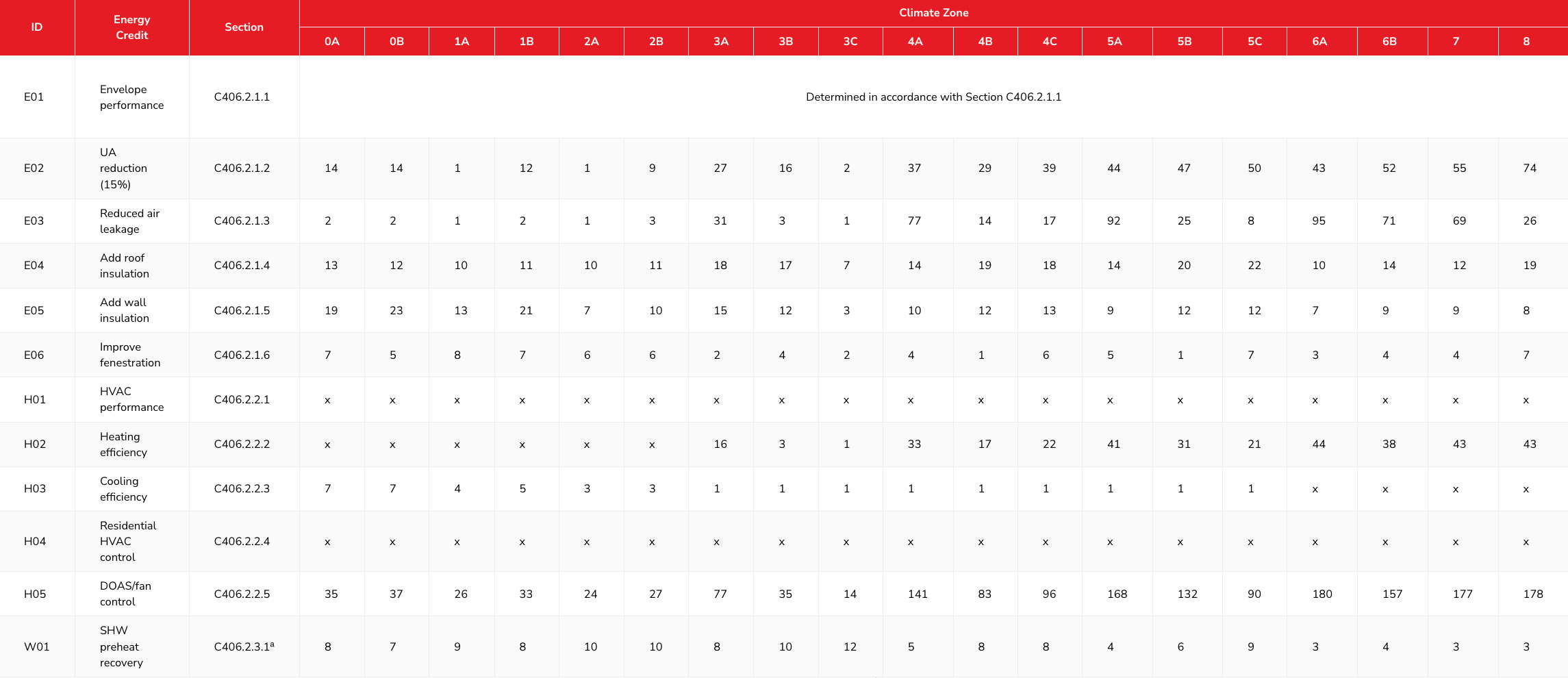
Source: IECC 2024
Even though the credit options and their assigned values have changed, the path to compliance is still relatively the same. A majority of the credit requirements can still be achieved through reducing air leakage and adding roof and wall insulation. For IECC 2024, I would also suggest adding DOAS/fan control as an energy credit choice. The DOAS option is found in Section C403.8 of the mechanical section and involves a dedicated outdoor air system (DOAS) that delivers 100% outdoor air for ventilation without operating the main heating and cooling system.
This is where coordination becomes important. If there are questions about the energy credit choices for a metal building project, entering the mechanical and lighting inputs into COMcheck early can help the team see which credits are already being captured and which ones still need to be addressed.
This increased visibility gives the entire project team a clearer picture of the full compliance path early on, instead of leaving those decisions until later in the process.
How to Run a Successful COMcheck Under IECC 2024
For contractors, erectors, designers, and builders working on metal buildings, the best way to run a successful COMcheck under IECC 2024 is to treat the credit requirement as an early design task.
Here’s what a practical approach to COMcheck compliance under IECC 2024 may look like:
- Confirm the climate zone and occupancy type first
- Review the required credit total before finalizing the envelope
- Use the envelope strategically through added roof and wall insulation and reduced air leakage
- Coordinate early with mechanical and lighting so those inputs are available in COMcheck
- Review the referenced code sections for every credit category selected
When these steps are handled early on, the team is in a much better position to build a smooth compliance path and avoid surprise revisions later.
Subscribe to The Code Man Blog
Subscribe to my email list to get my next update delivered straight to your inbox.
All for now,
Bill “The Code Man” Beals
—–
Bill Beals, District Manager of Therm-All, is a 40-year veteran of the metal building industry and a contributing member of several committees, including the Metal Building Manufacturers Association’s Energy Committee and the National Insulation Association’s Laminators Committee. Bill also belongs to ASHRAE and the International Code Council (ICC). He has contributed to over 100 articles and reference guides on commercial energy codes, and has instructed AIA-accredited courses for over eight years. Bill was inducted into the Metal Construction News Hall of Fame in 2024.