
A Guide to Metal Building Insulation
In this article:
Metal buildings have come a long way since their major adoption in the mid-20th century. Lean manufacturing, building science innovations, and increasingly stringent energy codes have propelled our industry toward new heights. While this has led to incredible energy and cost efficiencies, it also means a change in metal building insulation systems and processes; gone are the days of installing 6” R-19 roof insulation and 4” R-13 wall insulation on all projects. New materials, systems, and methods of installation have emerged over the last 15 years, many of which are here to stay. So, what should you know when evaluating insulation for metal buildings and ensuring a successful insulation install? Let’s break it down.
What Is Metal Building Insulation?
Not all metal buildings need insulation. Structures such as simple metal garages, barns and storage sheds often do not require insulation. Additionally, some projects require less insulation than others. Known as “semi-heated spaces” throughout commercial energy code literature, a semi-heated metal building falls between a fully conditioned space and an unconditioned space. Warehouses that don’t need to be maintained at a constant temperature and agricultural buildings that only require freeze protection are examples of semi-heated metal buildings. The majority of metal buildings in the U.S., however, are conditioned spaces and are expected to comply with the minimum insulation requirements outlined in governing commercial energy codes.
Metal buildings are unique in the way they are insulated. A metal building envelope is a combination of materials that joins the foundation, wall and roof assemblies, and doors and windows. Unlike conventional commercial construction, a typical metal building insulation application includes an exposed vapor retarder which faces toward the interior of the building plus a layer or two of faced or unfaced fiberglass.
Metal building insulation comes in a variety of material types, including fiberglass, rigid foam board, and insulated metal panels. Several important factors should be considered when deciding which material is best for a project, including energy code requirements, project budget, and end-use of the building.
Benefits of Insulating a Metal Building
Because metal is a strong conductor of heat, hot and cold air easily enter and escape metal buildings. Air infiltration in a metal building can lead to a variety of issues, including poor temperature regulation, increased energy use, and every building owner’s worst nightmare: condensation. Properly installing an insulation system that meets the latest standards and certifications offers several key benefits for metal buildings:
Regulates temperature: Insulation reduces the transfer of heat into and out of a metal building, which helps the structure’s HVAC system control the interior temperature. This leads to a more comfortable, consistent environment throughout the building.
Improves energy efficiency: By better regulating the building’s heating and cooling system, metal building insulation helps reduce energy usage, which can lead to significant cost savings for building owners.
Prevents condensation: Condensation occurs when warm, moist air comes in contact with cold surfaces, such as framing members, windows and other accessories, or the colder region within the building envelope if moisture has penetrated the vapor retarder. Trapped moisture can cause corrosion of metal components and degrades the insulation’s thermal performance. Metal building insulation reduces the temperature difference between the metal framing and interior building air, reducing the potential for condensation to occur. Additionally, a good vapor retarder is the first and last line of defense in combatting condensation. We cover vapor retarders in more detail below, but for now it’s important to know that the proper selection and installation of the vapor retarder helps prevent condensation in a metal building.
Absorbs sound: Metal buildings can be prone to echoing and noise transmission. Metal building insulation absorbs sound waves, improving sound quality and creating a quieter interior environment. Sound abatement is especially useful in recreational facilities and buildings that store loud equipment.
Finished interior appearance: In a traditional metal building insulation application, the exposed vapor retarder faces out toward the interior of the building, providing an attractive finished appearance that may allow for reduced lighting loads.
What are the Most Common Metal Building Insulation Types?
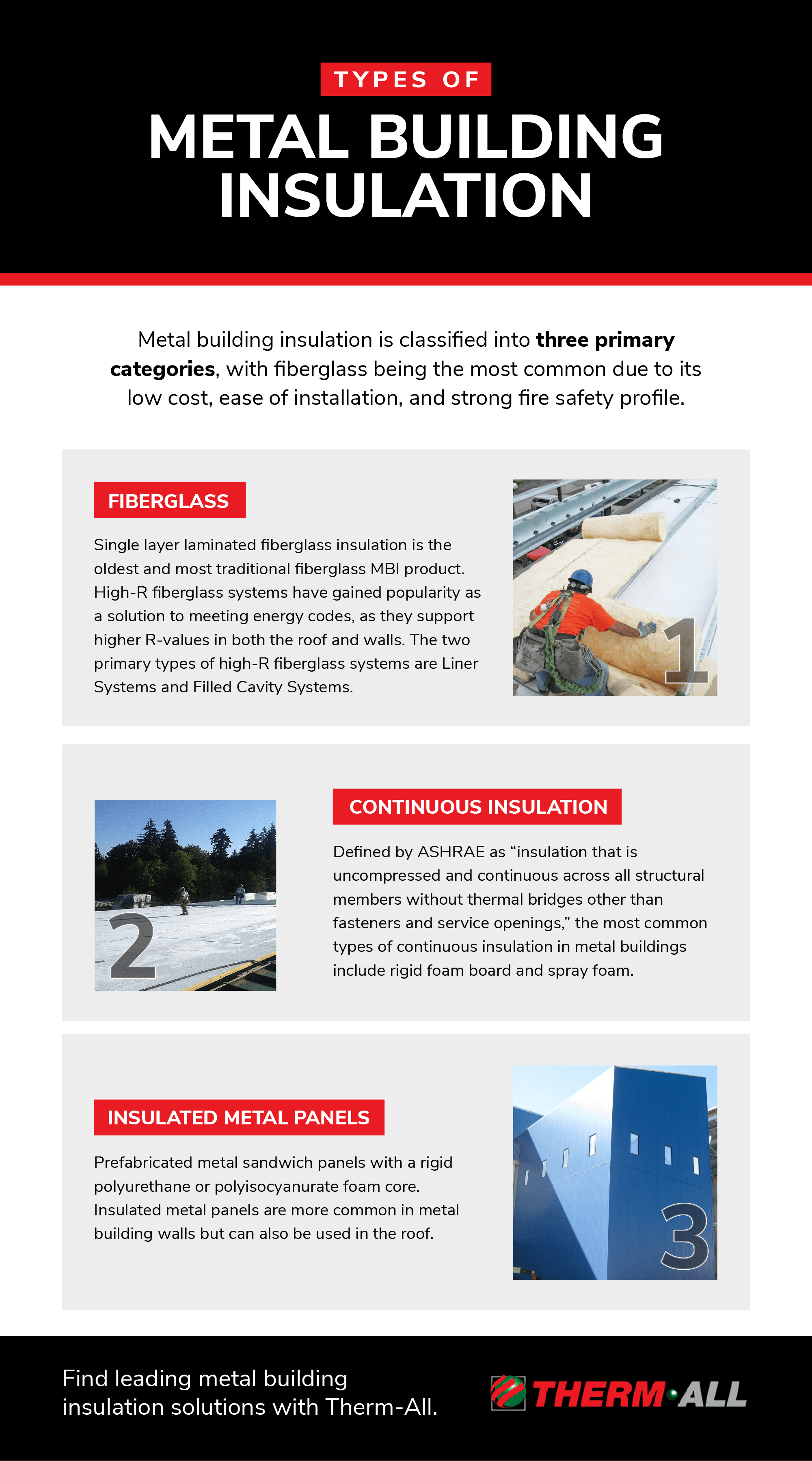
Metal building insulation is classified into three primary categories:
1. Fiberglass insulation, which consist of one, two or three layers of faced or unfaced fiberglass (or a combination) in either the roof or walls.
2. Continuous insulation systems most often consist of a rigid polyisocyanurate or polyurethane foam core and can be used in roofs and walls.
3. Insulated metal panels are lightweight composite exterior wall and roof panels with metal skins and an insulating foam core.
Fiberglass Insulation
Fiberglass insulation is the most common metal building insulation material type. Often referred to as fiberglass batts, fiberglass rolls, or metal building insulation rolls, fiberglass insulation offers several advantages, including:
- Can provide the lowest installed cost per R-value
- Easy to install and does not require heavy equipment
- Eco-friendly (Owens Corning’s EcoTouch® contains an average of 65% recycled content and is GREENGUARD Gold Certified)
- Delivers an excellent thermal and acoustical performance
- Sound-absorbing acoustic properties
- Enhances light reflectivity and reduces lighting costs
Types of Fiberglass Insulation for Metal Buildings
Fiberglass metal building insulation comes in a variety of configurations for metal building roofs and walls, including:
Standard Single Layer Laminated Fiberglass Insulation is the oldest and most traditional fiberglass product, and consists of a vapor retarder laminated, or adhered to, a single layer of fiberglass. Single layer laminated is installed between the outside face of the purlins and exterior metal roof and between the girts and the exterior metal wall panel.
High-R Fiberglass Systems have gained popularity as a solution to providing more insulation in metal buildings in order to meet increasingly stringent energy codes. The term “High-R” stands for “high R-value” and we refer to these as “systems” because they are just that – a system of various materials, such as fiberglass, a vapor retarder, support banding, and screws.
There are two main types of high-R fiberglass systems on the metal building market:
1. Banded Liner Systems (Ls) are designed for use in roofs and walls of metal buildings and are suitable for both new construction and retrofit applications. Banded Liner Systems consist of two layers of unfaced fiberglass, a low permeance fabric which serves as the vapor retarder, and banding that runs both parallel and perpendicular to the purlins. The fabric vapor retarder is attached to and completely covers the bottom of the purlins, creating an attractive finished interior appearance. Some Banded Liner Systems offer fall protection and meet the definition of Liner System (Ls) throughout the energy code literature.
2. Long Tab Banded Systems (FC): Also called “Long Tab with Banding” or “High-R Banding”, Long Tab Banded systems are designed for use in metal building roofs only and are a lower cost option to Banded Liner Systems. Typically non-proprietary, Long Tab Banded systems are comprised of two layers of fiberglass, one laminated with a vapor retarder and one unfaced, plus banding which runs perpendicular to the bottom of the purlins. The laminated layer of insulation is installed between and parallel to the purlins, while the unfaced layer of fiberglass is installed on top of and perpendicular to the purlins. The purlins are left exposed in a Long Tab Banded application, providing easy access to electrical, HVAC, and other trades. Long Tab Banded systems meet the definition of Filled Cavity (FC) throughout the energy code literature.
Mineral Wool
Mineral wool, which is “made from rock, blast furnace slag, and other raw materials,” is sometimes used in metal building roof and walls due to its strong thermal, acoustic, and fire protection performance. Common metal building applications include structures that store loud machinery, such as compressor stations. Mineral wool is typically not manufactured in sizes that are common for metal building applications, which is why typical applications include an additional material, such as fiberglass, to comply with commercial energy code requirements.
Continuous Insulation (CI)
Continuous insulation is defined by ASHRAE as “insulation that is uncompressed and continuous across all structural members without thermal bridges other than fasteners and service openings”. Per IECC, continuous insulation “can be installed on the interior or exterior or is integral to any opaque surface of the building envelope”. Continuous insulation systems have become more prevalent in metal buildings over the last decade and offer several benefits, including:
- High R-value per inch
- Superior protection against thermal bridging, which occurs when a more conductive element (i.e. something with a poor insulating value) creates an easy pathway for heat flow across a thermal barrier
- Easy to install
Note that any exposed board insulation should be verified for fire rating as an exposed product.
Types of Continuous Insulation for Metal Buildings
Rigid Insulation Systems
The most common type of continuous insulation for metal buildings consists of a rigid polyisocyanurate or polyurethane foam core, which are often referred to as “rigid insulation systems” or “rigid board”. Most rigid insulation systems can be used in both the roof and walls of metal buildings and meet the definition of “CI” throughout energy code literature. Rigid board products are purchased in sheets and are installed on the exterior framing members of a metal building. Many of today’s rigid insulation systems are durable solutions for meeting commercial energy codes, including mandatory air barrier requirements. It’s important to note that rigid board products require specific fire testing in order to be used in exposed metal building applications.
Spray Foam
Spray polyurethane foam, or spray foam for short, is most commonly used as a supplemental material to fill cavities in metal buildings but can also be used as a primary insulation method in smaller structures with through-fastened roofs. The chemical mixture is sprayed onto interior of the roof and wall panels which creates a continuous thermal barrier. There are two classes of spray foam products: Open-cell and closed-cell foam, the latter of which is used more commonly in metal building applications as it better prevents condensation from forming on the steel framing. Note that spray foam should not be used as a primary insulation material for standing seam roofs, as it may restrict roof panel movement. When spray foam is used as the primary insulation material, several additional steps beyond other material applications should be taken, including (1) Informing the metal building manufacturer, as warranties may be affected; and (2) Demonstrating fire rating performance.
Insulated Metal Panels (IMPs)
Insulated metal panels have gained popularity in the metal building market over the last 20 years, largely due to their superior thermal properties, versatile aesthetic appearance, and durability. Insulated metal panels are exactly what they sound like – the most common iteration consists of two prefabricated metal sandwich panels with a rigid foam core (typically polyurethane or polyisocyanurate). Mineral wool is also used as the core insulation material in some IMP products, though rigid foam is more typical. Insulated metal panels are more commonly used in metal building walls but can also be used in the roof. They provide continuous insulation throughout the building envelope, are more durable than other types of metal building insulation, and come in a wide variety of colors, finishes, and profiles. Insulated metal panels are the highest-cost metal building insulation option and often require heavy machinery during installation.
How Do You Insulate a Metal Building?
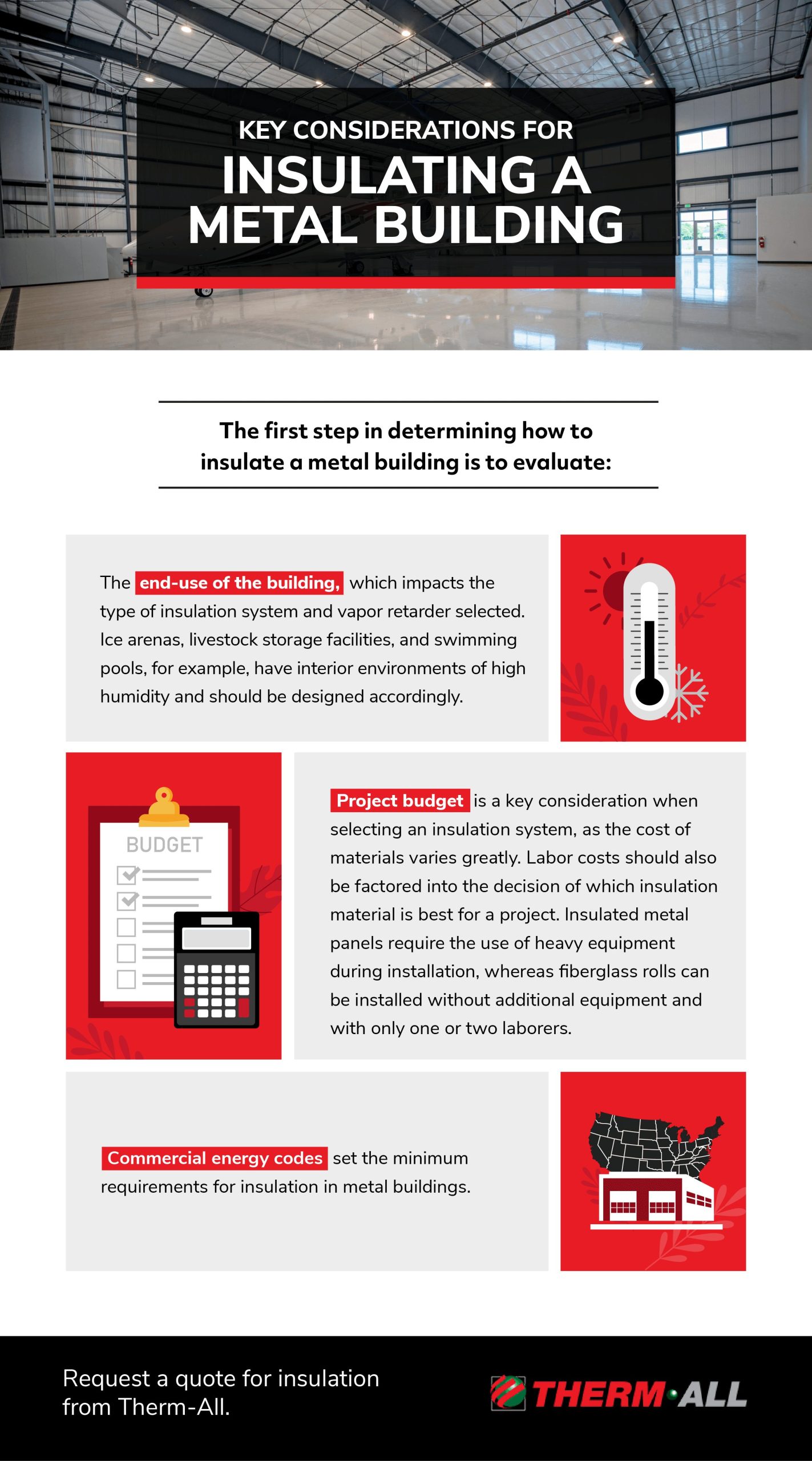
The first step in determining how to insulate a metal building is to evaluate the following factors:
1. The end-use of the building impacts the type of insulation system and vapor retarder selected. Ice arenas, athletic facilities, livestock storage buildings, and swimming pools, for example, have very specific requirements to consider when choosing an insulation system.
2. Project budget is a key consideration when selecting an insulation system, as the cost of materials varies greatly. Fiberglass tends to be the most cost-effective option while insulated metal panels are the most expensive.
3. Climate zone (project location) dictates the minimum amount of insulation needed in a building as outlined in the energy code adopted at the state or local level.
Next, understanding the basics will help in determining how to insulate a metal building.
R-Value
The R-value of an insulation product is a thermal resistance rating that tells us how well a material resists heat flow. The higher the R-value, the better the insulation performs at restricting heat transfer. R-values for metal building insulation range from R-8 to R-30. The most common fiberglass metal building insulation R-values include:
- 2” (R-8 before lamination)
- 3.4” (R-10)
- 3.7” (R-11)
- 4.3” (R-13)
- 5.3” (R-13)
- 6.3” (R-19)
- 8.0” (R-25)
- 9.25” (R-30)
It should be noted that thicknesses are nominal, as manufacturers produce different thicknesses to meet R-values. Commercial energy code requirements dictate the minimum R-value necessary for all new construction, additions, and alterations performed in the U.S. It’s important to check your state’s or local jurisdiction’s adoption to ensure your project meets applicable energy code requirements.
U-Factor
A U-factor, which is also called a U-value, measures heat transfer, or loss, through the assembly over time. While the R-value measures a single product’s ability to resist heat, the U-factor measures the entire assembly’s resistance to heat transfer. The lower the U-factor, the better the insulation. Mathematically, R-values and U-factors are reciprocals of one another; U-factor = 1/R-value, R-value = 1/U-factor.
Vapor Retarders
Vapor retarders, or facings, are specifically designed and engineered to protect metal building insulation from physical abuse and moisture migration, and are offered in a variety of permeance, or “perm”, ratings. A perm rating measures the amount of water vapor that can penetrate a vapor retarder under certain conditions. The lower the perm rating, the better the vapor retarder. Vapor retarders are currently available with perm ratings ranging from 0.02 to 0.9. Additionally, today’s vapor retarders are equipped with unique properties designed to accommodate nearly every end-use, ranging from classic standard duty vapor retarders, which are used in warehouses, to specialty facings for high-abuse environments, such as athletic facilities. It is crucial that contractors and insulation suppliers discuss the end-use of the building to ensure the best vapor retarder for the job. Vapor retarders are typically white, black, or reflective, and provide a finished interior appearance.
Air Barriers
The purpose of an air barrier is to limit uncontrolled air leakage into and out of the building’s envelope. A building envelope is defined as roof, wall, and floor area that encloses a heated or cooled area. Uncontrolled leakage will result in increased energy usage due to lost heating or cooling. Air barriers were made a mandatory provision in the IECC 2015/ASHRAE 90.1-2013 commercial energy code cycle, which means that they are required on all metal building projects in states that have adopted the IECC 2015/ASHRAE 90.1-2013 code cycle or newer code cycles. An air barrier must be located within the building’s thermal envelope; it can be placed on the interior side, exterior side, somewhere within assemblies composing the envelope, or any combination thereof. It is also mandatory to identify the air barrier in drawings and for it to be continuous across joints and assemblies.
Radiant Barriers
A radiant barrier is a reflective foil material used in metal buildings to reflext radiant heat from the sun and maintain a more stable indoor temperature. The foil material reflects radiant heat away from the interior of the building in the summer months and toward the interior of the building in the winter months. In most metal building applications, radiant barriers are combined with an insulation material, such as fiberglass rolls. Radiant barriers can also be used as a standalone product in non-conditioned buildings, such as garages, storage sheds, barns, and other structures that do not require insulation.
Energy Codes
Commercial energy codes have changed the way we insulate metal buildings and are perhaps the most important factor to consider when deciding how to insulate a metal building. The International Code Council (ICC) and the American Society of Heating, Refrigerating, and Air Conditioning Engineers (ASHRAE) are the two major councils that set forth the IECC code and ASHRAE standard, respectively. The IECC code is published every three years. The IECC code references some of the ASHRAE 90.1 Standard plus any addendums. ASHRAE 90.1 follows behind the IECC code by two years. For example, ASHRAE 90.1-2019 is the IECC 2021 code with addendums. You’ll often see the IECC code and ASHRAE 90.1 Standard referenced as a code “cycle”; for example, “the IECC 2024/ASHRAE 90.1-2022 code cycle”. Some states adopt the IECC code and some adopt the ASHRAE 90.1 Standard; some states have their own energy code entirely. Additionally, energy codes can be adopted at the state or local jurisdiction level.
We recommend following these steps to determine the building envelope requirements for your next metal building project:
1. Check your state’s status.
2. Review of the prescriptive U-Factors for both the roof and walls depending on your building type (conditioned vs. semi-heated).
3. Contact your insulation supplier to discuss the best insulation system for your project, which is dependent on two of the factors we’ve already reviewed – end-use of the building and project budget.
Why Work With Therm-All?
For starters, we’re the #1 commercial energy code resource in the metal building industry. We are a Continuing Education Provider with the American Institute of Architects, helping architects, engineers, designers, and builders stay at the top of their field through a variety of learning opportunities each year. In fact, we offer more AIA-accredited courses than any other metal building insulation laminator. We also started the first ever blog dedicated to commercial energy codes 10 years ago. We offer a robust code-focused product line and our sales team is trained to provide our customers with A-to-Z energy code compliance. In fact, we’ll even run a free COMcheck™ building envelope compliance report with every order. We believe it’s our job to know the codes inside and out so that you don’t have to.
Contact Our Expert Team Today
We’ve been a leading metal building insulation solutions provider for over 43 years. We’re dedicated to providing a superior, reliable product that meets all standards and certifications while delivering the best customer service in the business. We take pride in our reputation as a leading metal building insulation supplier and partner to our customers.